


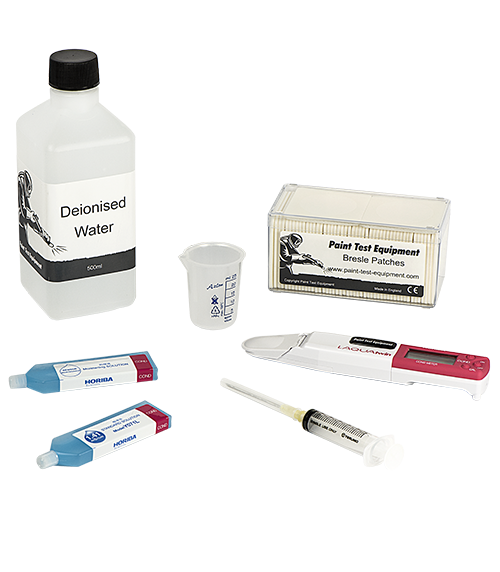

Paint Test Equipment P2005 Bresle Chloride Test Kit


The Bresle Chloride Test is one of the most popular tests for extracting and measuring the salt contamination on blast-cleaned substrates.
This Chloride Test on steel or Salt Test on steel using the Bresle Patch or Bresle Sampler method will help to prevent coating failure due to salts such as chlorides and sulphates contaminating the surface prior to the coating application.
This Chloride Test on steel or Salt Test on steel using the Bresle Patch or Bresle Sampler method will help to prevent coating failure due to salts such as chlorides and sulphates contaminating the surface prior to the coating application. This contamination can be tested quickly and simply using the Bresle Test.
The Bresle Test is one of the most popular tests for extracting and measuring the salt contamination on blast-cleaned substrates.
Easy to use, pour 10mls of distilled water into the beaker and determine the conductivity using the Conductivity Meter. Take a Bresle Patch and apply to the test surface. Fill the syringe with 2.5mls of test water and insert through the adhesive foam into the test chamber. Inject the contents, then extract back into the syringe. Repeat ten cycles of injecting and extracting, then transfer the test water back into the beaker. Measure the test water with the Conductivity Meter and deduct the initial conductivity reading from the result. Multiply the readings by 0.4 to give the quantity of salts in g/cm also known as ppm, or by 4 for the quantity of salts g/m.
The maximum permissible surface density of salts on the steel surface prior to surface treatment depends on the type of paint to be applied and what the finished material or product is to be used for. Surface treatment specifications must, therefore, state the highest permissible surface density of salts for each particular application.
Complies with International Standards: ISO 8502-6 and ISO 8502-9.
Additional packs of Bresle Patches (Bresle Samplers) can be purchased to carry out further tests using this kit.
Kit Contents
- Bresle Patches (pack of 35)
- Conductivity Meter
- 500ml Deionised Water 500ml
- 5ml Syringe with Needle
- Calibration Solution (14ml)
- Conditioning Solution (14ml)
- 25ml Beaker
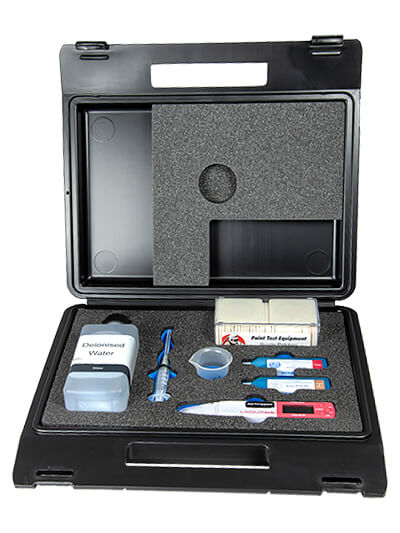
- Carrying Case
Features
- Conductivity Meter Accuracy: 2.
- Conductivity Meter range: 01999S/cm
- Conductivity Meter resolution: 1S/cm
- Storage: Do not expose the Bresle Patches to any extremes of temperature or daylight.
- Shelf Life: The only degeneration on the Bresle Patches is the adhesive if exposed to extremes of temperature.
- We would recommend that the Bresle Patches are used within a 12-month period from date of purchase.
Specifications
| P2005 | Bresle Test. Includes 35 Bresle Patches |
| NP001 | Conductivity Meter Calibration Certificate |
| NPC01 | Conductivity Meter Calibration Solution Conformance Certificate |
| NPC04 | Bresle Patches Conformance Certificate |
Downloads
 | Paint Test Equipment Bresle Chloride Test Kit with Certificates - Data Sheet |